Being lovely
All the Bright PlacesBeing lovely is a recurring idea in Theodore Finch and Violet Markey’s story: beauty first appears as something they notice in places and words, then becomes a way of understanding what love can do for a person. Its significance rests on that shift. Loveliness is not only a quality of a view; in Finch’s song, it is something one person helps another feel, and which Violet keeps after Finch is gone.
From ordinary places to shared beauty
Their first Indiana high point offers no grand spectacle. At Hoosier Hill, a sign gives the elevation as 1,257 feet, while the marker is a wooden stake among stones, hardly larger than a pitcher’s mound. Violet finds the destination underwhelming. The mismatch between the name of a high point and its modest physical presence makes the episode a useful counterpoint to later moments: significance does not depend on grandeur, and an ordinary place can acquire meaning through attention and experience.
At Bookmobile Park, the landscape initially presents itself as an unexpected sight: seven book trailers stand in a line amid cornfields, their different shapes rising against the flat surroundings. Violet recalls the family book hunts she once shared with her parents and Eleanor, in which each person chose a book and the group visited however many stores it took to find them all. The setting therefore brings a former family ritual into the journey with Finch. The scene does not call the trailers lovely; rather, it shows how a place can gather meaning from what a person remembers and shares there.
That relation between a place and the people who see it becomes explicit atop Purina Tower. After climbing the steel ladder, Finch and Violet sit close together under a blanket beside the Christmas tree that remains there all year. Below them, town lights and dark patches of trees resemble stars scattered across the ground, while stars in the sky make the boundary between earth and sky difficult to distinguish. Violet calls the view lovely. Finch responds by valuing the word itself and saying that the town feels as if it belongs to them. The exchange joins language, landscape, and intimacy: the beauty is real, but its emotional force comes from sharing it.
Loveliness as a way of being together
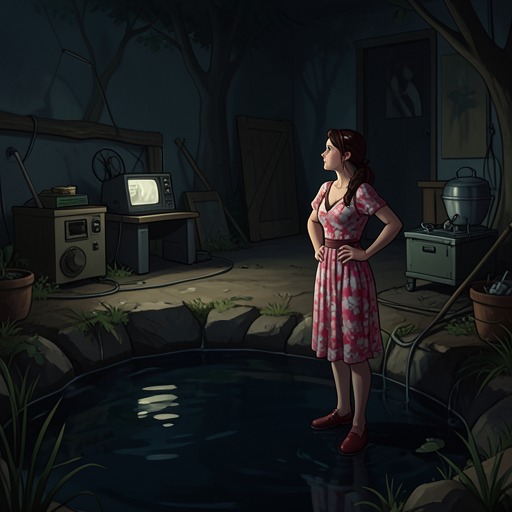
At the Blue Hole, Finch leads Violet down to a private, round pool ringed by trees. He imagines them as the only two people on earth, wishing the solitude could be real. The setting carries danger as well as quiet: Finch recounts stories of a bottomless lake, quicksand, an underground current, missing swimmers, and a whirlpool that nearly pulled two deputies under. The scene’s beauty is therefore not presented as proof that a place is safe. It exists alongside uncertainty, and the couple’s presence gives the secluded water an intimate meaning without erasing its risks.
The idea also returns in a brief later sequence that places a lake and a prayer beside the thought that it is lovely to be lovely in Private. The phrase links loveliness to a specific landscape and to prayer, but does not explain precisely when Finch visited or what he experienced there. Its placement before everything goes quiet lets the words resonate without resolving those questions. After Violet reaches the Blue Hole again, she recognizes the water’s color as like Finch’s eyes. The same place now bears the force of memory: what once belonged to a shared visit has become a point in her search for him.
Finch’s song and Violet’s inheritance
At Taylor Prayer Chapel, Violet finds an envelope containing three sheets of staff paper: one covered in musical notes and two in words that appear to be lyrics. The song makes the idea personal through its repeated address to its recipient. It begins with “You make me happy,” and later tells that person, “You make me lovely.” The phrasing presents loveliness not as a fixed trait or outward appearance but as an effect of being loved: the beloved feels happier, special, and lovely in the presence of the person singing.
Violet reads and rereads the lyrics until she knows them by heart. She folds the pages back into the envelope, stays in the chapel until her tears subside and the light fades, then takes the staff paper home. There, she plays the notes on her flute. The melody remains with her and she is still singing it days later. The movement from written pages to memory, breath, and repeated song gives the phrase a concrete afterlife. Finch is absent, but his words remain something Violet can carry and perform.
Meaning and limits
Across these moments, being lovely gathers meaning gradually: a modest destination, a town seen from above, a secluded lake, and finally a song. The novel does not make the phrase a simple promise that love can prevent loss or make every place safe. The Blue Hole’s dangers and Violet’s grief resist such certainty. Instead, the song offers a more bounded form of consolation. Finch’s words affirm what Violet meant to him, while her return to them—reading, playing, and singing—shows how an intimate expression can continue to matter after the relationship has been cut short.